
A metal card that feels “serious” in the hand changes the conversation before anyone reads your name. That’s the point. Thickness is tactile marketing. It’s also a manufacturing constraint, a compatibility risk, and, if you pick wrong, a quiet source of returns and annoyed customers.
I’ve handled enough metal cards to tell you this: people don’t remember your alloy choice. They remember how it felt when they picked it up.
Thickness: not a vanity metric, a usability boundary
Thickness sounds like a spec-sheet detail until you live with the card for a week. Then it becomes physical reality: pocket bulge, wallet tension, how it slides into a tight slot, how it clacks onto a table.
Here’s the baseline way to think about it:
– Thicker = stiffer + heavier feel + “premium” signal
– Thinner = easier carry + fewer compatibility headaches + cheaper unit economics
And no, there isn’t a universal “best” thickness. There’s only “best for the way the card will be used.” If you’re considering which size is right for your needs, understanding the nuances of metal card thickness can help you make a more informed choice.
One-line truth:
A card is either a daily tool or a brand prop, and thickness pushes it toward one side.
Gauge, stiffness, and that “this feels expensive” moment
Look, “gauge” gets thrown around casually, but what people actually experience is stiffness, edge presence, and weight distribution. Those factors are influenced by thickness, yes, but also by the metal, the temper, and how the card is finished.
What changes as thickness goes up?
Bending resistance climbs quickly. Dent resistance improves. Edges feel more defined (sometimes too defined if finishing isn’t dialed in). The card makes a slightly different sound when set down. That last one sounds silly until you watch someone do it in a meeting.
In my experience, stiffness is the real luxury cue, not raw thickness. A thin card in a hard alloy with clean finishing can still feel high-end. A thick card with sloppy edge work feels like a gimmick.
A quick technical aside (because it matters): for a flat plate, bending stiffness scales roughly with the cube of thickness under simple assumptions. That means going from 0.6 mm to 0.8 mm isn’t a “small bump.” It can be a big jump in perceived rigidity.
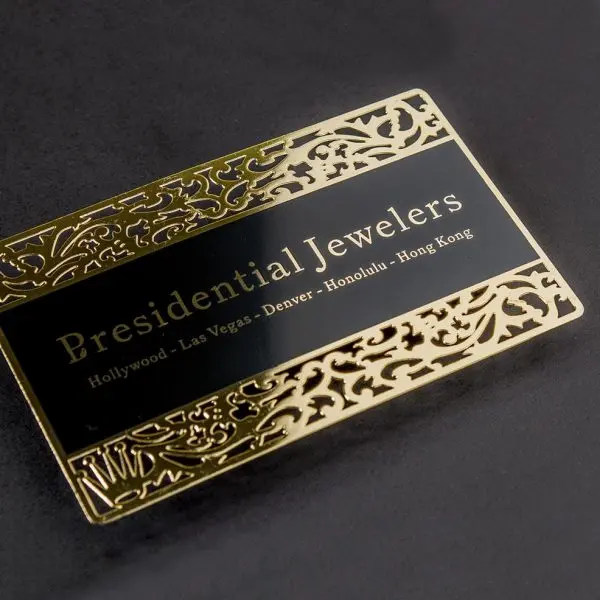
Wallet fit + readers: where “premium” can get annoying
Your users won’t write a complaint that says “tolerance stack-up.” They’ll just say the card is “kind of a pain.”
Even tiny thickness increases can cause:
– Wallet slots stretching over time
– The metal card “printing” against other cards and making stacks uneven
– Slower in-and-out friction (especially in minimalist wallets with tight cutouts)
What about card readers?
Now, this won’t apply to everyone, but if your card is meant to behave like a standard payment card, you’re playing in a world built around ISO/IEC 7810 ID-1 sizing, including a typical thickness of 0.76 mm for standard PVC payment cards (ISO/IEC 7810:2019). That reference point matters because a lot of readers, slots, and wallet designs implicitly assume it.
And RFID/NFC? Thickness alone usually isn’t the villain. Coil design, antenna placement, metal isolation, and shielding strategy matter more. Still, if you push thickness and change the stack (coatings, inlays, adhesives), you can end up with “why does it tap weirdly at this one terminal?” moments.
Here’s the thing: compatibility failures are rarely universal. They’re situational. One subway gate. One access reader. One older POS.
Costs: thickness is expensive in more ways than material
Most people think thicker cards cost more because “more metal.” True, but it’s only part of the bill.
Thicker metal can mean:
Longer cycle times. Tougher machining. More tool wear. More scrap risk if flatness tolerance is tight. Sometimes higher shipping costs if you’re sending lots of cards in bulk.
On the flip side, thinner cards may demand more careful handling during production to avoid warping, and certain finishes don’t behave as nicely on thinner stock if the surface prep isn’t consistent.
Opinionated take: if you’re trying to hit a price point, don’t default to thin. Default to manufacturable. A slightly thicker card that yields cleanly and consistently can beat a thinner card that creates rejects and rework.
What thickness signals to buyers (before they know anything else)
People form the “quality verdict” fast. Not after reading features. Not after scanning a QR code.
The sequence is usually: pick up → feel weight → notice edges → see finish → decide if it’s legit.
Premium signal, simplified
A thicker-feeling card implies:
– durability
– seriousness
– “this brand invested in this”
That’s why thickness works as a shortcut to perceived value. It’s a physical cue, and physical cues are persuasive in a way product copy isn’t.
But (and this is a big but) if the card becomes annoying in real life, hard to carry, awkward in a wallet, inconsistent with readers, you don’t get credit for being premium. You get blamed for being impractical.
Use-case matchmaking: choose thickness like you’re designing a tool
If the card is used constantly
Access control. Daily tapping. Pulled out ten times a day. You want reliable fit and predictable performance more than dramatic heft.
If the card is a brand moment
VIP cards. high-end membership. limited drop. Handed over in person. Thickness can be turned up, because the “first impression per interaction” is the whole game.
If it’s mass distribution
Events, campaigns, big-volume programs. Thinner often wins on cost and logistics, but don’t go so thin it feels disposable. People can sense “cheap” instantly, even when they can’t explain why.
I’ve seen programs do well by choosing a thickness that feels confidently solid without forcing the user to reorganize their wallet. That middle ground is boring on paper and excellent in the wild.
Practical testing beats debating (every time)
You don’t need a lab to learn the basics. You need a few prototypes and a little honesty.
Test this stuff in real life:
Put it in a tight wallet. Stack it with other cards. Sit on it. Slide it into a reader if it’s supposed to work with one. Drop it onto concrete. Carry it for a week and see what the edges look like.
Pay attention to edge wear and corner mushrooming. Those show up earlier than people expect.
And if you want one clean data anchor to keep the team grounded: standard ID-1 cards commonly target 0.76 mm thickness per ISO/IEC 7810 (ISO/IEC 7810:2019). You can deviate, sure. Just know what “normal” is before you decide to be different.
Communicating value without overselling (a messaging trap people fall into)
Thickness isn’t a feature. It’s an outcome driver.
So don’t market it like: “Now 20% thicker!” That’s how you end up sounding like a mattress company.
Talk about what the user gets:
– “Resists bending in pockets and wallets”
– “Clean edge finish that stays crisp”
– “Feels substantial without fighting your wallet slots”
Measurable language wins. So does restraint.
A decision framework that won’t waste your time
Start here, not with aesthetics:
- Compatibility requirement: does it need to behave like a standard card in readers/wallets?
- Handling frequency: occasional presentation or constant daily use?
- Finish + edges: can your supplier keep edges consistent at the thickness you want?
- Failure tolerance: are you okay with “works for most people” or does it need “works for everyone”?
- Economics: not just metal cost, yield, scrap, lead time, shipping, replacements
Then order samples. Multiple thicknesses. Same design. Same finish. Compare like-for-like.
Because the user will.
Quietly, instantly, and without reading a word you wrote about it.